Wednesday, October 12, 2011

Tribe WAR VIII Explodes in Gaisano City Part I by: James U. Sy Jr.


Founder/Master James U. Sy Jr. of Conceptual Martial Arts Society (CMAS), Inc. demonstrating doble baston which combined movement patterns from the systems of Herada Pigada, Lapu-Lapu Viñas Arnis, Oido de Caburata, Romero Arnis de Mano, Singkatan, and Yasay Sable during the Tribe WAR (Warriors Art Rumble) VIII last October 8, 2011 at the Atrium Area, Gaisano City Bacolod Supermall, Araneta St., Bacolod City (CMAS Photo).

Tribe WAR (Warriors Art Rumble) VIII was successfully held by Tribu Hangaway Philippines (THP) of Master Roy R. Flores, 6th Degree Black Belt, in cooperation with Aksyon Radyo Bacolod under Station Manager JJ Ocampo and Gaisano City Bacolod Supermall last October 8, 2011 at the Atrium Area, Gaisano City Bacolod Supermall, Araneta St., Bacolod City. Four teams saw action in ten action-filled Submission Grappling bouts while six other organizations gave various demonstrations of combative Korean, Japanese, Thai, and Filipino Martial Arts.

Overall champion was Tribu Hangaway Philippines (THP) of Master Roy R. Flores with 7 wins and Submission Sports Philippines-Bacolod Team (SSP-BT) of URCC fighter Adrian Hillana at 2nd place with 3 wins. Other competing teams were Strike and Shoot Bacolod (S&SB) headed by Angelo Nazario and Iloilo Alliance Mixed Martial Arts (IAMMA) led by 4 times World Wushu Sanshou champion Rene Catalan of Sta. Barbara.

DEMONSTRATIONS. Black Dragon Martial Arts Moo Duk Kwan Tang Soo Do Soo Bahk Do of Chief Instructor Wendell Billones showed an assortment of Hangul Mudo “Korean Martial Ways (Hangul)” exhibitions which included basic and advance WTF Taekwondo and Soo Bahk Do poomse “forms,” basic, obstacle, and high altitude falling techniques, and various self defense techniques for children, women, men, holdup and snatching, striking and kicking, and knife attacks. Black Dragon had the most performers for the event, with a total of 32 demonstrators. Soo Bahk Do Grandmaster Casimiro “Chingi” Grandeza, 7th Dan Black Belt, Founder of White Kimono, “The father of Karate in Negros,” was in attendance to give support to the students.

Russell Mohametano Sensei, this time representing his own Arashi Ryu Aikido, demonstrated a few Iaido kata “forms.” The exhibition continued with Mohametano Sensei and his two assistants performing Aikido self defense techniques against different empty handed and armed attacks, with the use of nage waza “throwing techniques (Nihonggo)” and kansetsu waza “joint locking techniques (Nihonggo).”

The Universal Defensive Tactics Academy (UDTA) of Founder/Master Abraham “Abe” Ganzon was represented by Dr. John Philip T. Pestaño and Ricky B. Eslabon, who demonstrated the UDTA interpretation of Espada y daga “sword and dagger (Español).”

Master Elizalde Aspan represented the Carga Pigar Kalis Silat Arnis Club of Grandmaster danilo “Danny” l. Cardinal by performing an elaborate solo baston anyo. Founder/Master James U. Sy Jr. Conceptual Martial Arts Society (CMAS), Inc. gave a demonstration of doble baston which combined movement patterns from the systems of Herada Pigada, Lapu-Lapu Viñas Arnis, Oido de Caburata, Romero Arnis de Mano, Singkatan, and Yasay Sable.

Southeast Asian, 2 times Asian, and 4 times World Wushu Sanshou champion Rene Catalan of Sta. Barbara and his brother 2011 world Muay Thai champion Robin S. Catalan waved the banner of the Iloilo Alliance Mixed Martial Arts (IAMMA) as they demonstrated the fundamental and advanced techniques of Muay Thai “The Art of the 8 Limbs” from Thailand.

The demo team of host Tribu Hangaway Philippines (THP) of Master Roy R. Flores was led by Instructor Jared Turbanos in showing the falling techniques, evasion and leading, jointlocking, and throwing techniques of Combat Aikido, the Filipino version of Ueshiba, morihei O’Sensei’s Aiki Budo. Master Flores and Instructor Turbanos also showed knife defense and knife vs knife.

OLPA Hosts Sport Arnis Seminar


English and Filipino teacher Mrs. Ariane M. Ignacio and
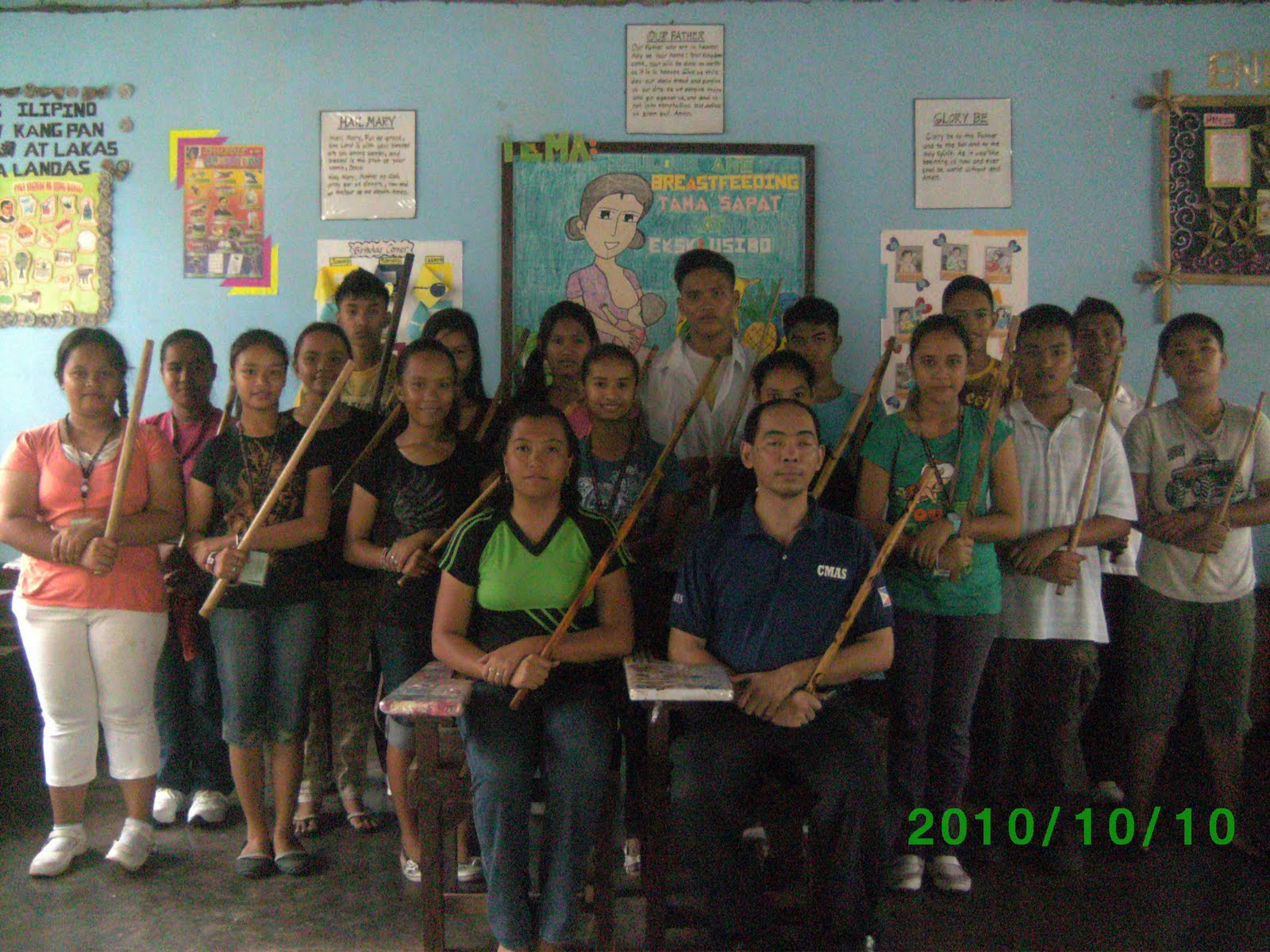
Founder/Master James U. Sy Jr. of the Conceptual Martial Arts Society (CMAS), Inc. (seated) with participants of the 1st OLPA Sports Arnis Seminar last October 10, 2011 at the Our Lady of Peace Academy (OLPA), Brgy. Ma-ao, Bago City (CMAS Photo).


English and Filipino teacher Mrs. Ariane M. Ignacio organized the 1st OLPA Sports Arnis Seminar last October 10, 2011 in one of the classrooms of the Our Lady of Pillar Academy (OLPA), Brgy. Ma-ao, Bago City. The seminar was attended by 16 of the 21 students expected to represent the academy during the Area Meet Arnis Competition this coming October 13-15, 2011 at the La Consolacion School Isabela Negros Occidental, Inc. in the Municipality of Isabela.

Resource Instructor was Founder/Master James U. Sy Jr. of the Conceptual Martial Arts Society (CMAS), Inc., PIO of Arnis Philippines-Negros Occidental Chapter and Negros Occidental Baston Federation (NOBF), Inc.

Ignacio, who was originally a MPEH teacher, previously commissioned Grandmaster Sabas T. Gubaton of the Oido de Caburata Arnis Group (ODCA) to serve as the Trainor for the Arnis Team of OLPA. The lesson focused on the fundamentals of the particular style of Arnis of GM Gubaton for use in the DepEd Labanan category. The OLPA Arnis Team made their debut this year at the Division Meet. Since then the lessons with GM Gubaton ended.

Ignacio, wanting to maximize the training of OLPA players, invited Sy to teach a seminar on both Anyo and Labanan events with their corresponding set of rules. Sy had studied and is certified in different systems of Arnis by various grandmasters, among them Oido de Caburata Arnis Patriarch GM Abraham T. Gubaton and Chief Instructor GM Sabas T. Gubaton. He had attended a number of Sport Arnis seminars conducted by Arnis Philippines-Negros Occidental Commissioner Grandmaster Danilo L. Cardinal. Mary Camille Gubaton and Joshelle Rianne C. Gubaton, the granddaughters of the Gubaton grandmasters who studied basic empty handed conceptual women’s self defense under Sy, recommended Sy to Ignacio.

Sy began the seminar with doble baston fundamentals as components of the anyo. Finer points were given for the wrist position, angling of the weapon, body torque, force generation, proper breathing, and proper body alignment. The training then proceeded to the Labanan category where Sy used the Yasay Sable system of the famed Yasay Clan of Bago City as the teaching format for sparring. Students were taught basic positioning, evasive footwork, otso-otso, strike interception, and basic competition strategy. A portion of the seminar was devoted to the athlete’s conditioning. The seminar closed with a few demonstrations of combative arnis applications.

Those who participated in the seminar were Carlos Miguel Alisaje, Ryan N. Arguelles, Melchora J. Baylosis, Karlos Enrique Duyo, Wilson D. Espejo, Joshelle Rianne C. Gubaton, Chris Adolf V. Jeruta, Christine Joy Landero, Divine E. Malunes, Roger A. Manong, Ma. Cecelia Denice G. Miape, John Mark G. Niña, Cresiani Jay R. Rabay, Alodia Faye G. Somcio, Esther Ruth G. Somcio, Vanessa G, Torrecarion, and Josea Elaine May V. Tulog.

Mrs. Ariane M. Ignacio organized the Sport Arnis seminar with the support of Principal Candelaria Balbao.

Saturday, October 8, 2011

TAI CHI CIRCLE BACOLOD (TCCB)’s LECTURE @ YUAN THONG TEMPLE A PRELUDE TO CHENG MANCHING 37 FORM

by Narciso (Hansy Alojado, Instructor of TCCB, cellphone number 09287195141)
(from left to right:Humberto (toti0 LIM, Hansy Alojado, Ana from Russia, Jenn from Samar, Renee from Manila Jarrin from Canada, Sifu Peter Yap,Kattie from Germany, a student from Russia, a student from Bacolod, Monk Master, Bill Gomez Cora Romero, , Loubert Sajo, and Nena King.)

“There are 3 friends who were students of martial arts. They were bragging to ech other the feats of their masters. The first one said that his master could break hollow blocks, slabs of stone or wooden planks with his bare hand. The 2nd student would not be outdone by the first one said that his teacher/master could leap over high fences and could leap upward to some tall buildings. The third one just said softly that his teacher eats when he is hungry, drinks when he is thirsty and lie down when he is sleepy. Upon hearing this the two friends exclaimed in unison, “What! your teacher is just a normal human being.” The 3rd student just said, “Yes my teacher is normal but yours are abnormal!”

With this story, Sifu Peter Yap of TCCB group, concluded his talk/lecture on Tai Chi. He was invited /requested to give a lecture on Tai Chi by Mrs. Terry Gochangco, the president of the Yuan Thong Temple at Burgos St., Bacolod City, to the 4th batch of live-in students from Russia, Germany, Manila, Samar and Bacolod, studying at the temple on different arts.The instructions/sessions is free of charge.

The story, I think, summarizes the whole lecture of Sifu Peter Yap wherein he encourages/advocates the normal/natural way of practicing Tai Chi. One does not have to have extra efforts in practicing the form. Why do you have to exert tremendous effort just to get to the tall building when one can use the stairs or ladder. Or why do you have to punish oneself by using your barehand in breaking the ice when one has to use an ice pick to crack it. We do not exert extra effort during our practice at TCCB. As Sifu Petr Yap mentions in his talk, putting extra effort beyond the natural way is sometimes detrimental for the cultivation of chi or life force. This is one of the principles that we practice at TCCB with the guidance of Sifu Peter Yap.

Sifu Peter Yap demonstrated by example when he mentions about the basic principles which should be present during the practice of Tai chi. Aside from the example by doing, Sifu Peter even used Chinese characters mentiond in the Tai Chi forms and gave different meanings of a single Chinese character according to context using the white board.

At the open forum, he answered questions with ease, aplomb and spontaneity with matching demonstration, the health benefits of tai Chi, the different harmonies (esternal and internal). He even fielded questions about food and matching diet.

Sifu Peter Yap said that unless your Tai Chi has all the requirements, your tai chi is just an ordinary calisthenics or Tai Chi look-alike. Tai Chi is bio-energetics not a mechanical/muscular mimicry.

His lecture/talk was a summary of his casual conversation after TCCB’s formal practice every MWF evening at Oceanlite, Singcang, Bacolod, as well as every Saturday and Sunday morning at the Capitol Lagoon. Sifu Peter Yap would make it a point to attend every practice session if the weather permits.

So join us in practicing tai chi, the TCCB way, which is the natural/normal way

.

Tuesday, September 20, 2011

Tai Chi & Dance: Harmony in Motion Part I: The Constant Flux That Changes Martial Arts by: James U. Sy Jr.


Peter Yap Sifu in a Tai Chi posture at Tai chi Circle of Bacolod headquarters (James U. Sy Jr./CMAS Photo).


Martial arts had always been an important part of Asian life and culture since the ancient times. Fighting skills were a necessity to survive against conquest and pillage by neighboring kingdoms and in later times, European colonialists. The martial arts were used to strengthen the clan, tribe, kingdom, or empire regardless of in what part of Asia it was located. Various warrior classes, such as the errant knights of China, the Samurai of Japan, the Hwarang of Korea, the Ksathriya of India, and the Bagani of the Manobos in the Philippines among others, were developed.

However, no martial art, no matter how evolved it is, can withstand the power behind gunpowder. The incursion of western powers, such as the Spaniards, Portuguese, British, Dutch, and Americans, into Asian commerce and political affairs cost Asians countless lives in defense of their lands. Over time the martial arts declined in popularity as its most skilled exponents perished in these wars for freedom, the imperialists banned the arts, firearms took center stage in the battlefields, and industrialization and modernization shaped a new society.

Among the martial arts systems caught in these changing times was Tai Chi Chuan “Grand Ultimate Fist (Mandarin).” There are legendary accounts of the art’s roots but what is historically verifiable is that it was first recorded in the Chen Village in China. It was here that Yang Lu-Chan learned Chen Style and later evolved it into Yang Style. Yang made modifications to the art he learned. The old Chen style had lower stances due to the fact that warriors wore armor in earlier times. But in Yang’s time, this was no longer the case so he raised the stances and made other pertinent revisions.

Fast forward to the 21st Century, a time which is no longer plagued by anarchy and chaos, at least in a general sense. Tai Chi Chuan is now practiced by millions for the purpose of health and longevity. While there are still a few who teach the martial applications of the art, the health aspects of Tai Chi took center stage to combat the more pressing concerns of stress and illness in the more fast paced modern life. Various studies, many of which were conducted in modern day China, had confirmed the health benefits of Tai Chi.

In Bacolod, the oldest group practicing the art is the Tai Chi Circle of Bacolod (TCCB), which was founded way back in July 17, 2000. While there were ethnic Chinese residing in Negros who practiced Tai Chi in the earlier days, they did not teach and kept the art to themselves and their families. There were early teachers but there’s no cohesive group to talk of. TCCB was nowhere in public view until this writer first wrote about the group around the middle of the first decades of the 2000’s. Their patriarch, Peter John Lloren Yap Sifu, at first refused an interview because they were not a commercial group. The group shared Tai Chi for those interested for free; that was the main reason why this writer endeavored to introduce them to the greater public.

Yap Sifu’s journey to Tai Chi started late in life. All he wanted was a cure for the aches he amassed from years of hard labor during his younger days. Tai Chi helped him cope with this problem. Through TCCB Yap Sifu wanted to share this gift from the Chinese civilization and help its members live more comfortable and productive lives inspite of existing medical conditions. Yap Sifu knows the martial applications of Tai Chi but he believes maintenance of one’s health and well being is the priority of training, at least for his group, because most members are civilians who wouldn’t be faced with conflict most of their lives.

Tai Chi Chuan, as taught by Yap Sifu, is dedicated to the focused study of the teachings of the late Grandmaster Chen Man-Ching. Yap Sifu teaches in a scientific manner rather in cryptic and mystical jargon. For instance, he emphasizes proper musculo-skeletal alignment during movements, which is very essential in maintaining the integrity of the joints and avoid tears to the muscles, ligaments, and tendons. Breathing is natural and not forced or artificial. Speaking in such understandable terms enables practitioners to easily comprehend the essence of what they are taught and thereby progress significantly in the art in a less period of time.

In several conversations with Yap Sifu, this writer discovered that he has tapped another application of Tai Chi Chuan, something unheard of, at least here in Bacolod, and something that some have criticized to be out of bounds. This is the application of Tai Chi principles and movements to dance. This we will discuss more in the second part of this article.

Wednesday, August 24, 2011

Bacolod’s Jalene G. Thomas: The Beauty and the Voice by: James U. Sy Jr.


Pilipinas Got Talent (PGT) singing sensation Jalene G. Thomas of Bacolod City (James U. Sy Jr.photo).


Pilipinas Got Talent (PGT) singing sensation Jalene G. Thomas of Bacolod City (Thomas family photo).


Jalene G. Thomas of Bacolod City at the Pilipinas Got Talent (PGT) Cebu auditions (Thomas familyphoto).


Jalene G. Thomas of Bacolod City with Pilipinas Got Talent (PGT) hosts Bill crawford and Luis Manzano (Thomas family photo).

Without a doubt Pilipinas Got Talent (PGT) is today’s premier primetime talent show in the Philippines. It has showcased a wide assortment of talents across the archipelago from people representing different ethnolinguistic groups coming from all walks of life. In the pilot session of the show Negros did not shine that much. But in the next two editions, the Negrense talents started popping up. So far, Bacolod, Escalante, Hinigaran, San Carlos, and Talisay had been represented.

One such talent captured not only the ears of the viewers but also their hearts. With the beauty comes the voice that matches it. I had the chance to meet up with Jalene G. Thomas of Bacolod City last week for an interview. I’m grateful to Mrs. Brilla Ellery Yap Yu for linking us. What follows is the transcript of the interview.

JUSJ: Tell us a little about yourself.

JGT: I was born to Robert "Bob" Thomas and Jean Geriane Thomason July 2,1994 in Sacramento, California, USA. My dad is half Kapampangan, half American while my mom is a native of Brgy. Ma-ao, Bago City, Negros Occidental. I have a younger sister, Julia.

JUSJ: When did you start singing?

JGT: When I was 4 years old, I would grab a broom and stand on top of the table and sing. My grandma just loved it and she bought me a magic stick. From then on I was singing non-stop. However, I didn’t take formal voice lessons.

JUSJ: What prompted your family to go back to the Philippines?

JGT: I was going to get my high school education here. We arrived in 2007 and I was originally enrolled at Our Lady of Pillar Academy (OLPA) in Ma-ao. Later my mom made me transfer to Colegio de San Agustin-Bacolod (CSA-B) because it was nearer to our residence in Bacolod and would save me lots of time traveling. I graduated last March 2011. This coming January 2012 I’m going back to the States to pursue a college degree, probably in business at the Sacramento State University. And hopefully once I graduate I plan to pursue studies in the performing arts in New York. After my education I plan to go back to Bacolod to establish my own business.

JUSJ: How do you find Negros?

JGT: Initially it was a culture shock for me. In Ma-ao almost everybody knows everybody, they being relatives to a certain degree. So when I started schooling at OLPA, it was always, “O, may Kana!” People would know I’m dayo lang. At times, somebody would approach me and say, “Hi, I’m your tita.” People there are close knit and warm. I also had to adjust to how things are done there. The Filipino subject was the hardest for me.

JUSJ: How did you enter Pilipinas Got Talent (PGT)? And how has it changed your life?

JGT: My dad saw it on TV and asked me if I wanted to join. I was hesitant at first but finally I joined the pre-audition at La Consolacion (LCC)-Bacolod. I sang Just Grenade. I was so happy when I was informed that I made it to the next round. I traveled to the Cebu auditions to represent Bacolod/Negros Occidental together with my cousin Wella Geriane Monville. There I sang Just the Way You Are and got a triple yes from the judges. I was so happy, way beyond words can describe. My family was very supportive. When I went back to Bacolod, people would recognize me, often times asking me if it’s really me. I would just smile and blush some. However, with so many good talents in the pool, I didn’t make it to the next round. I have to admit I felt bad at first but then life goes on. I’m just happy that people still give their support to me, even in FB. And I’ve proven that I have talent.

JUSJ: Aside from singing, what are your other interests?

JGT: I’m an emotional person but at times I become silent. In those times, I write a lot of poems, the free verse type. In fact I have loads of paper where I write them hehe. I blog. I also like reading, especially love stories and inspirational works like Chicken Soup. I did some Taekwondo (Chung Do Kwan) while in the US.

JUSJ: Last question. Do you have a BF?

JGT: Before I had but my parents wanted me to concentrate on my studies. But now that I’ve graduated from high school I have a special someone.

Arnis Tilt Set by: James U. Sy Jr.

The 1st Cargada Pigar Inter School Arnis Cup 2011 will be held by the Sum-ag Cargada Pigar Arnis Kalis Silat Club of Grandmaster Danilo “Danny” Cardinal this coming August 28, 2011 at the Sum-ag Gym, Brgy. Sum-ag, Bacolod City.

8 clubs had confirmed to participate: Bago, Cargada Pigar-Taculing, Cargada Pigar-Sum-ag National High School, Cauayan, Domingo Lacson National High School, Mandalagan Elementary School, Mansilingan Elementary School, and UDTA Bastonero.

Tournament officials will be GM Danilo Cardinal, Danny John Cardinal, Master Gualberto Dajao, Voltaire Daypal, Renane Deferia, Master Sheila Duran, Ricky Estabon, Master Abraham Ganzon Jr., and GM Joe Mancesa.

The tournament will be enforcing Arnis Philippines Inc. rules. Cardinal is the Commissioner of Arnis Philippines for Negros Occidental. An officiating refresher course for tournament referees and judges was held last August 14, 2011 at the Universal Caregiver, Locsin St., Bacolod City.

Wednesday, July 6, 2011

GMA’s Amaya: Fact or Fiction? Part IV: Religious Perspective By: James U. Sy Jr.


Dr. Juana J. Pelmoka wrote that the ancestral religion of the pre-Hispanic Filipinos was not paganism. The word paganism was derived from the word pagan, which itself was derived from the Latin pagus and referred to all religions who adored a false God. Under this definition, Judaism and Islam can not be called paganism because they believe in one true God. In the same manner, ancient Filipino religion can’t be called paganism because it believed in one true God (Pelmoka 111-112). Perdon pointed out that pre-colonial Filipinos were animists (Perdon 20).

This one true supreme God is known as Bathala, Maycapal, or Bathala Maycapal by the Tagalogs, Lauon/Laon by the Visayans (writer - particularly the Ilonggos), and by other names by other ethnic groups. Bathala came from the Sanskrit bhattara (Scott 40). Of the different names for the Filipino supreme God, Bathala is the one most often found in Philippine history textbooks. Bathala has also been known to have been used by the Cebuanos and Boholanos.

Amaya chose to use the name Abba to refer to the ancient Filipino supreme God. Abba is actually another term for Bathala. Abba was also among the old Cebuano words recorded by the Spanish chronicler Antonio Pigafetta in 1521 (Pigafetta).

Although Amaya mostly used the word Abba, it also made reference to Laon. In one scene, Dian Lamitan did mention the God Laon. In another scene, during the June 29 episode, when Amaya rose from the dead, an alabay who witnessed the event muttered, “Mahal na Laon!” The Panaynons used this name and later, with reverence, was applied to what is now known as Canlaon/Kanlaon in the mountainous regions of Oriental Negros. The original name was actually Kang Raon/Laon “For Raon/Laon (Kinaray-a).” It should be noted that even up to the present day Canalaon still holds a very esoteric part of Negrense life. Many have pilgrims to Canalaon every Holy Week in search of anting-anting and other esoteric powers or to simply comply with the yearly panumpaun “vow (Hiligaynon)” for those who own such magical items.

Bathala or Abba was supposed to be the creator of the universe and all things. Thus, he was superior to all other deities (Agoncillo & Alfonso 50; Pelmoka 119). The pre-Hispanic Filipinos had other lesser deities who had limited powers and their own functions or specializations, not unlike the Greek and Roman Gods. Magwayen, the Goddess of the Other World, was featured in one of the episodes of Amaya where the lead character was crossing the spiritual river after her death.

The pre-Hispanic Filipinos also believed in the Diwata who were spirits who dwell in nature. The word Diwata was derived from the Sanskrit devata and was well known for its distribution throughout the central and southern Philippines. Both Bathala and Diwata were variously applied to Gods, spirits, omen-birds, and idols (Scott 40). Diwa, the root word of Diwata, means “God, spirit” (Luengo 18). Pandaki, the righteous babyalan diwata, fought Magwayen for Amaya’s soul.

Archaeological finds show that ancient Filipinos practiced a local form of ancestor worship, which is an influence from the Chinese (Halili 51, 58). This would come to no surprise since the pre-Hispanic Filipinos had commercial relations with Sino traders since time immemorial and archaeological excavations show that Chinese porcelains are scattered all over the archipelago. Some other cultural influences by the Chinese, which were shown in Amaya, will be discussed in a future part of this series of articles.

In his La Antigua Civilization Tagala (1887), Paterno wrote that the soul of the dead was called Nono or Anito (Paterno 148). Note that the Tagalog word for ancestor is ninuno. The Visayans called their ancestor spirits umalagad, from the root word alagad “follower.” The spirit in the kapid “twin (Hiligaynon)” snake of Amaya is an umalagad. Paterno and Agoncillo likened the ancestor spirits to the saints of the Catholic Church (Paterno 148; Agoncillo & Alfonso 50-51). The early Filipinos believed these spirits could defend them before Bathala (Leogardo 29).

The pre-Hispanic Filipinos believed in the immortality of the soul and in life after death, much like Christians do. The Visayans believed that the soul of the dead went to either Ologan for good souls and to a place of doom called Sulad for bad souls, a concept very similar to the Catholic heaven and hell. The equivalents of Ologan and Sulad in Tagalog are Kawalhatian “State of bliss” and Kasamaan “Evil” (Agoncillo & Alfonso 50; Halili 58, Zaide 24; Pelmoka 120).

Ologan (or what was termed as Saad in the series) and Sulad were depicted in Amaya with visual distinction. The scene where Amaya was riding a baroto “small boat (Hiligaynon)” with Magwayen reminds me of similar scenes in old Greek-themed movies where souls of the newly deceased aboard the boat of Charon (Kharon) cross the rivers Styx and Acheron, which divides the world of the living and the world of the dead.

Amaya correctly depicted the spiritual leader of Rajah Mangubat’s banwa as a babaylan since the setting of the story is in central Panay. Babaylan is a term used in the Visayas and according to a Tausug friend of mine, is/was also used in pre-Islamic Mindanao. The priestesses of the pre-Hispanic Filipino animistic religion were variously known in different parts of the archipelago. Among these names are/were balyan or balian, baylan (Bagobo), baglan (Ilocano and Pangasinan), catalonan/katalonan (Tagalog), dawac, mambunong, mammalian (Pampango), mangngallag, and mumbaki (“Frequently Asked Questions”). It must be noted that while these priestesses may exercise similar functions and gifted with similar powers and skills, they must have differed from their other counterparts in certain aspects due to regional necessities and culture. So the use of the term babaylan is appropriate.

The babaylan had several functions: healer (hilot, herbalist), fortuneteller and diviner, shaman, ritualist, chanter, spiritual medium, sage, keeper of oral tradition, philosopher/adviser, etc. Because of the wide scope of natural knowledge the babaylan had, she had great influence in a barangay, just as was shown in Amaya where even Rajah Mangubat could not go against the words of the head babaylan.

The babaylan of pre-Hispanic Philippines were mostly females, usually elderly, just as was depicted in Amaya, which goes to show that women in those times held a an important status. A man can become a babaylan if he acts, dresses, and speak like a woman or if he is a transvestite (Chirino; Boncan et. al 78). In later centuries male babaylans were recorded to have led revolts against Spaniards and even against the Americans.

When the Conquistadores came they forcibly uprooted the babaylans from the Filipinos’ cultural foundation as to be displaced by Christianity, a move the babaylans opposed. Our history records that a number of revolts were led by Babaylans, noteworthy of these babaylan leaders were Tamblot of Bohol (Tamblot Uprising, 1621-1622), Tapar of Oton, Iloilo (Tapar Revolt, 1663), Ponciano Elopre (nom de guerre: Dios Buhawi) of Negros, and Dionisio Magbuelas (nom de guerre: Papa Isio; a.k.a. Dionisio Seguela & Dionisio Papa y Barlucia) (?-1911) of Himamaylan, Negros Occidental (babaylan rebellion, 1896-1907) (Halili 113, 118; “Philippine Revolts Against Spain”; “A Chronology: The Ilonggo Nation”; Bauzon 37; “Papa Isio Marker Unveiled”; Cuesta). Note that these babaylan leaders were males. Another uprising, Bankaw’s Revolt in Leyte (1622), was led by the aged chieftain of Limasawa Bankaw with his sons and the native priest Pagali (Halili 113).

In essence, Amaya infused life into these religious beliefs and practices gathered from our storied past, interpret it within the framework of the storyline, and present it in pleasing visual terms so viewers can internalize it better than if it were just in plain script in history textbooks. The visual presentation definitely helps in ingraining the data into the viewers’ subconscious. The broadcast media is without a doubt a powerful tool to convey ideas. It is in this way that Amaya differs from the average soap opera on TV.

“A Chronology: The Ilonggo Nation.” About Philippines. Retrieved: 5 Jun. 2011

Agoncillo, Teofdoro A. & Oscar M. Alfonso. History of the Filipino People. Quezon City: Malaya Books, 1967.

Boncan, Dr. Celestina P., May Dorothy dl Jose, Jerome A. Ong, John N. Ponsaran, and Dr. Grace Estela C. Mateo. Philippine Civilization: History and Government. Manila: Vibal Publishing House, Inc., 2006.

Chirino, Pedro. Relacion de las Islas Filipinas. Rome: (1604).

Cuesta, Angel Martinez. History of Negros. Manila: Historical Conservation Society, 1980.

“Frequently Asked Questions.” Center for Babaylan Studies (CFBS). Retrieved: 5 jun. 2011

Leogardo, Felicitas Tensuan, Vicente R. Leogardo, & Mr. Jacobo. A History of the Philippines. Manila: Philippine Book Company.

Luengo, Rev. Josemaria. A History of the Philippines: A Focus on the Christianization of Bohol (1521-1991). Bohol: Master Dei Publications, 1992.

“Papa Isio Marker Unveiled” Visayan Daily Star. 10 Nov. 2009: 14.

Paterno, Pedro M. La Antigua Civilization Tagala. Madrid: 1887.

Pelmoka, Dr. Juana J. Pre-Spanish Philippines. Caloocan City: Philippine graphic Arts, Inc., 1996.

Perdon, Renato. Footnotes in Philippine History. Sydney/Manila: The Manila Prints, 2008.

“Philippine Revolts Against Spain.” Wikipilipinas. Retrieved: 5 Jun. 2011

Pigafetta, Antonio. "First Voyage Around the World (1519-1522)" Document 15. Documentary Sources of Philippine History. Gregorio F. Zaide. Manila: National Bookstore, 1990. 81-210.

Scott, Dr. William Henry. Pre-Hispanic Source Materials for the Study of Philippine History. Quezon City: New Day Publishers, 1984.

Zaide, Dr. Gregorio F. Philippine History for High Schools. rev. ed. Manila: The Modern Book Company. 1969.